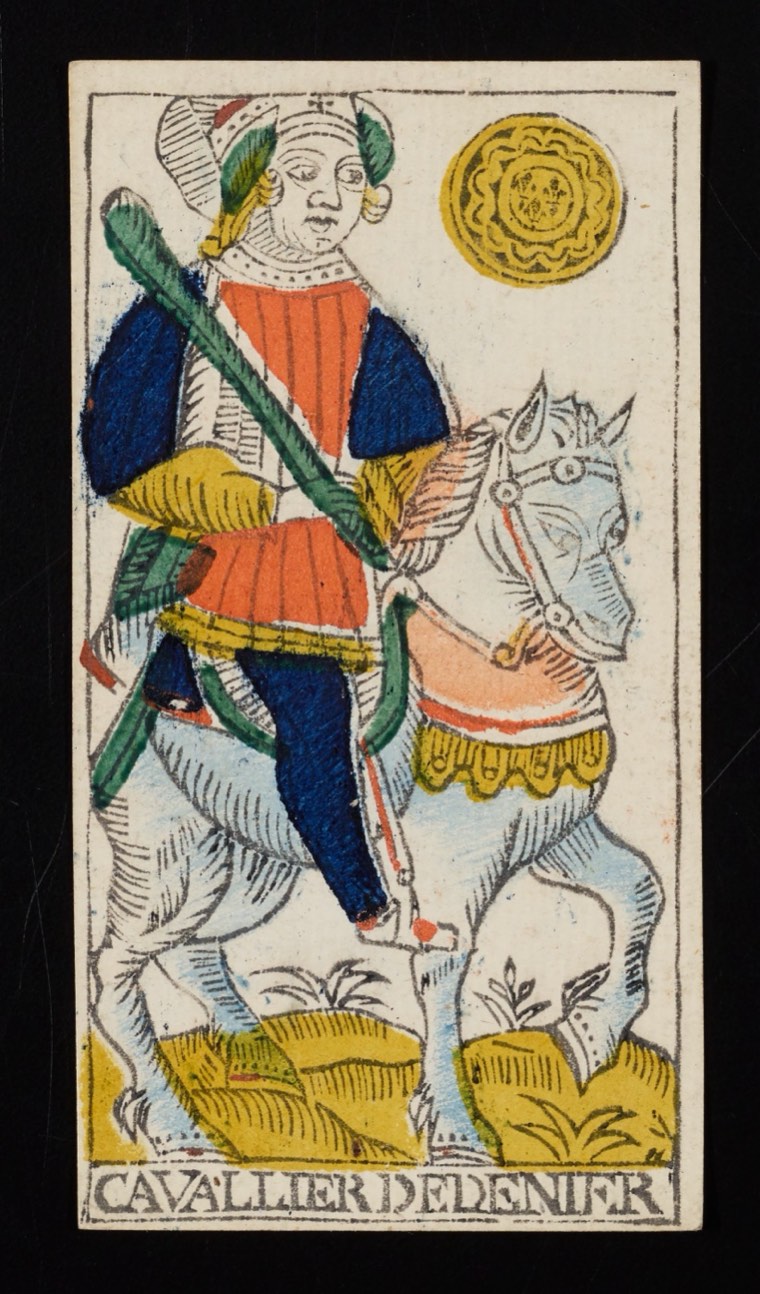
Court · Coins
The Knight puts the suit in motion.
The court is a relational stance toward resources, body, craft, stability, value, and material consequence; it need not describe a literal person.
Which visual cue makes Knight of Pentacles recognizable before reading its title?
01 · Body and direction
Read the figure before assigning a role.
Read the mount, direction, pace, carried emblem, and what the figure approaches or leaves.
Where is attention directed, and what relationship to the suit does the posture suggest?
02 · Suit relationship
Notice how the figure handles Coins.
Read centers, petals, fleur-de-lis forms, spacing, and the distribution of weight across the card.
Is the suit being received, carried, protected, displayed, controlled, or offered?
03 · Reading range
A court can be a person, stance, or demand.
The constructive range includes reliability, routine, and steady work; the difficult range includes stagnation, boredom, and obsession with routine. Decide from evidence whether the card names an actor, a way of acting, or a quality the situation requires.
How could reliability become distorted into stagnation in this situation?
04 · Practice
Carry material responsibility through consistent effort.
Carry material responsibility through consistent effort. Its constructive range includes reliability, routine, and steady work; its difficult range can include stagnation, boredom, and obsession with routine.
Where is this function active in the situation: Carry material responsibility through consistent effort.