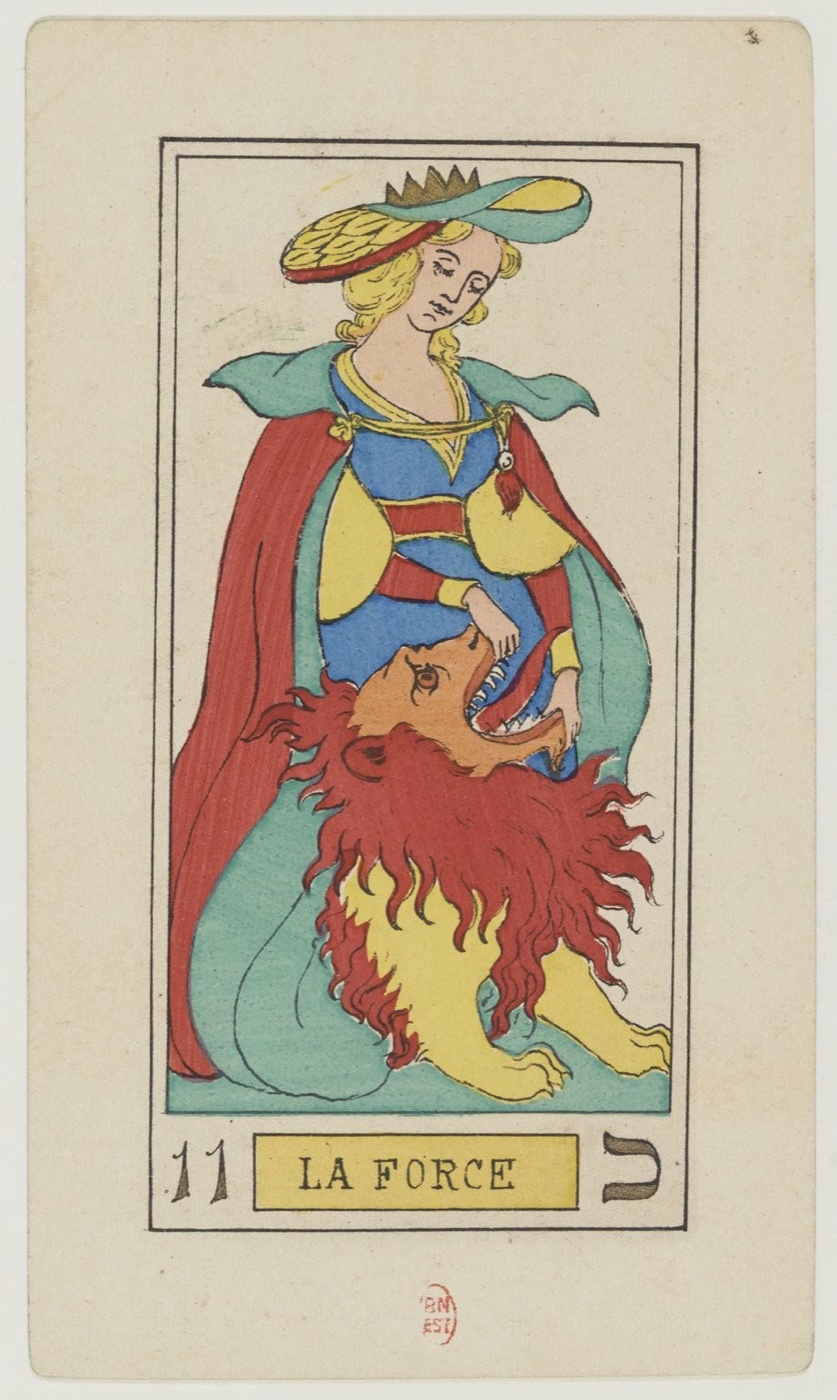
XI · Historical encounter
La Force
Begin with Wirth’s complete 1889 design for La Force. This object belongs to an original 22-card Major Arcana work; no Minor Arcana are implied or reconstructed.
Which visual cue makes Justice recognizable before reading its title?
01 · Visible construction
Read the emblem as a designed system.
Look for balanced weighing device or equivalent, decisive blade or instrument, frontal accountable posture, and symmetry or equilibrium while remaining faithful to what this edition actually depicts. Wirth’s geometry, gestures, lettering, and colour relationships are evidence—not decoration.
Which formal relationship organizes the card first?
02 · Reading range
Keep possibility and difficulty together.
The shared archetype can express truth, accountability, fairness, and cause and effect; under pressure it may appear as bias, dishonesty, and avoided consequence. The historical image determines how that range becomes visible here.
How could truth become distorted into bias in this situation?
03 · Comparison
One archetype, another occult vocabulary.
The original Wirth card number and title directly identify the same Major Arcana archetype.
What does Wirth emphasize that another deck leaves quiet?