Court · Batons
The Queen contains and governs the suit.
The court is a relational stance toward drive, work, growth, initiative, and directed energy; it need not describe a literal person.
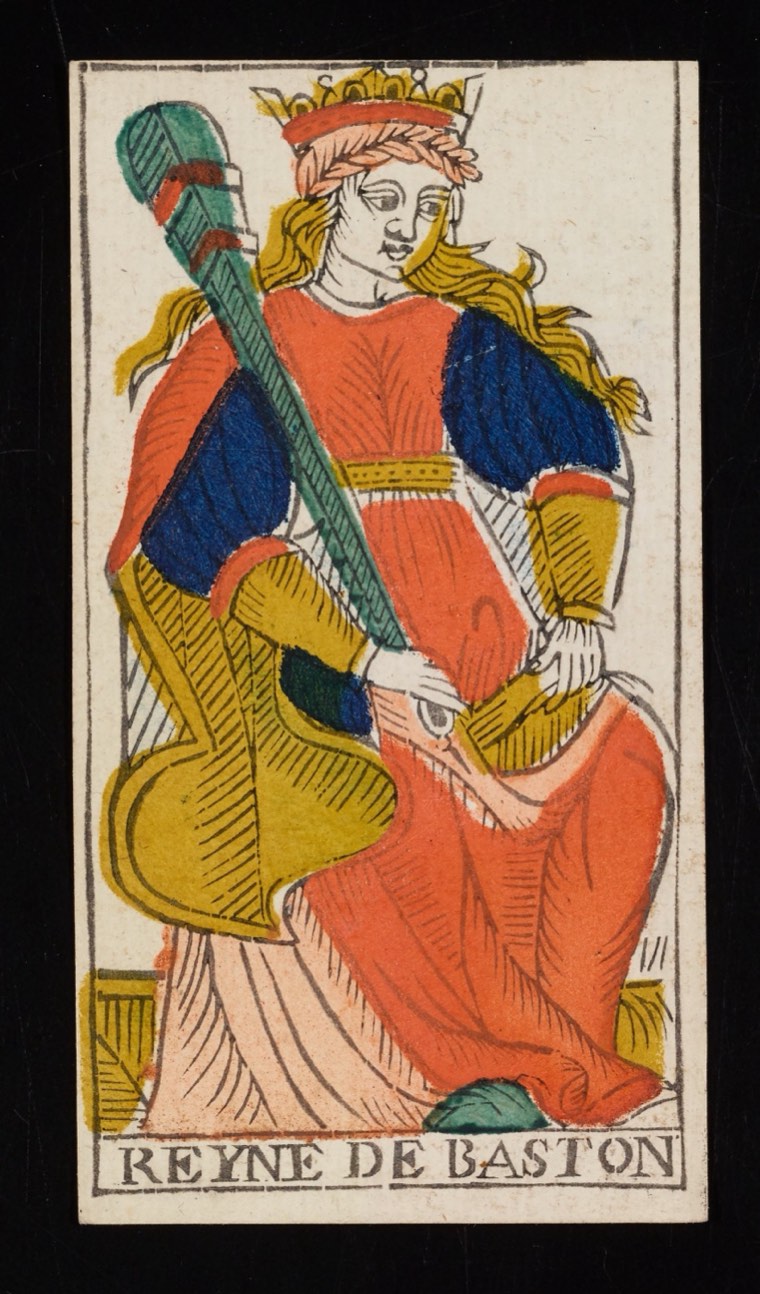
Which visual cue makes Queen of Wands recognizable before reading its title?
01 · Body and direction
Read the figure before assigning a role.
Read posture, gaze, throne or ground, held emblem, and the quality of inward authority.
Where is attention directed, and what relationship to the suit does the posture suggest?
02 · Suit relationship
Notice how the figure handles Batons.
Follow crossings, buds, cuts, and the direction in which the batons open or constrain movement.
Is the suit being received, carried, protected, displayed, controlled, or offered?
03 · Reading range
A court can be a person, stance, or demand.
The constructive range includes confidence, warmth, creative authority, and independence; the difficult range includes jealousy, insecurity, and demanding attention. Decide from evidence whether the card names an actor, a way of acting, or a quality the situation requires.
How could confidence become distorted into jealousy in this situation?
04 · Practice
Contain and radiate mature creative fire.
Contain and radiate mature creative fire. Its constructive range includes confidence, warmth, creative authority, and independence; its difficult range can include jealousy, insecurity, and demanding attention.
Where is this function active in the situation: Contain and radiate mature creative fire.