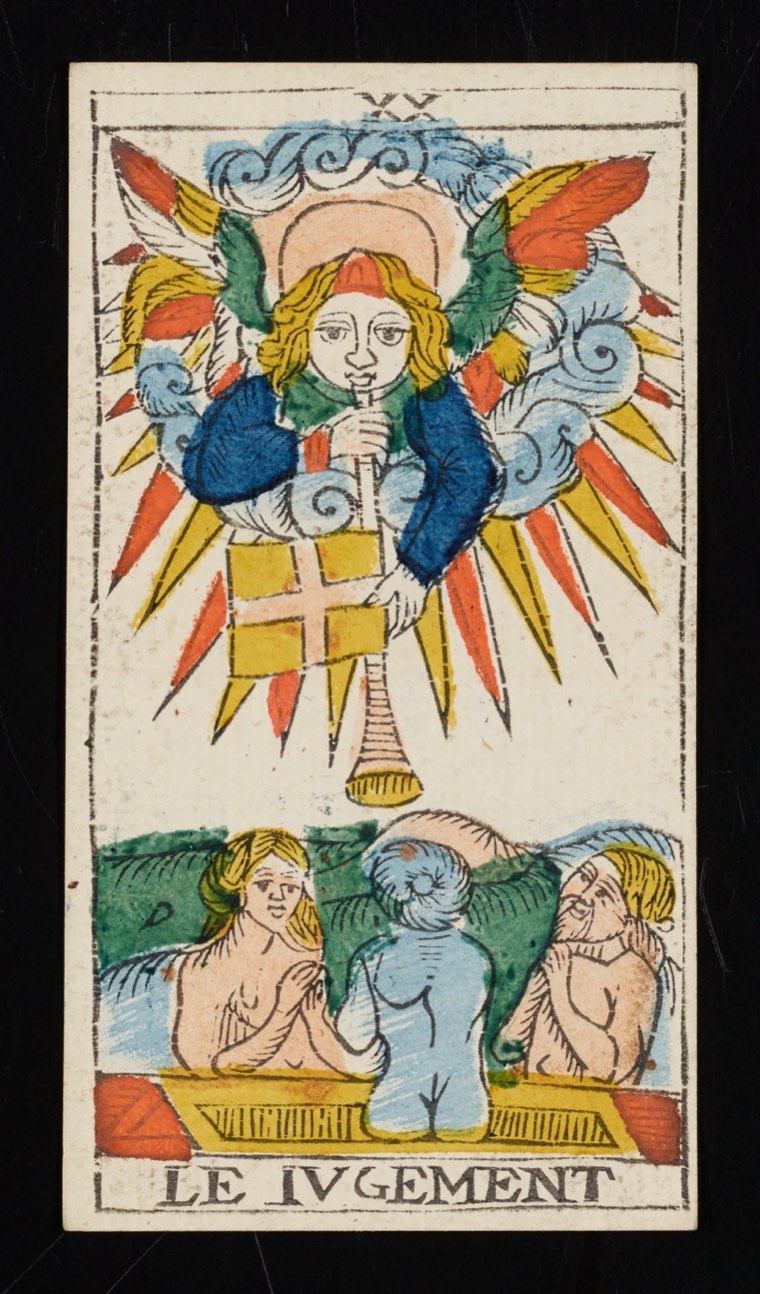
Trump · 20
Respond to a call that reinterprets the whole life.
Begin with the complete figure: posture, gaze, gesture, held objects, ground, title, and number. Respond to a call that reinterprets the whole life. Its constructive range includes awakening, calling, reckoning, and renewal; its difficult range can include self-doubt, refusal of call, and harsh self-judgment.
Which visual cue makes Judgement recognizable before reading its title?
01 · Direction
See where the figure and action move.
Facing, gesture, and placement create relationships before a keyword does. Notice what the figure approaches, refuses, carries, opens, or leaves behind.
What direction or relationship is visible before interpretation begins?
02 · Sequence
The number places this image in a larger movement.
Read the trump as part of a sequence after The Sun and before The World. Sequence offers contrast and development; it does not force one fixed spiritual hierarchy.
What changes when this card is read between its neighbors in the trump sequence?
03 · Reading range
Hold function and difficulty together.
Constructively, this image may speak through awakening, calling, reckoning, and renewal. Under pressure, it may show self-doubt, refusal of call, and harsh self-judgment. Context determines the expression.
How could awakening become distorted into self-doubt in this situation?
04 · Practice
Bring the visible action into the question.
Use the printed evidence to form a bounded interpretation, then test it against the spread position and the person’s actual circumstances.
Where is this function active in the situation: Respond to a call that reinterprets the whole life.