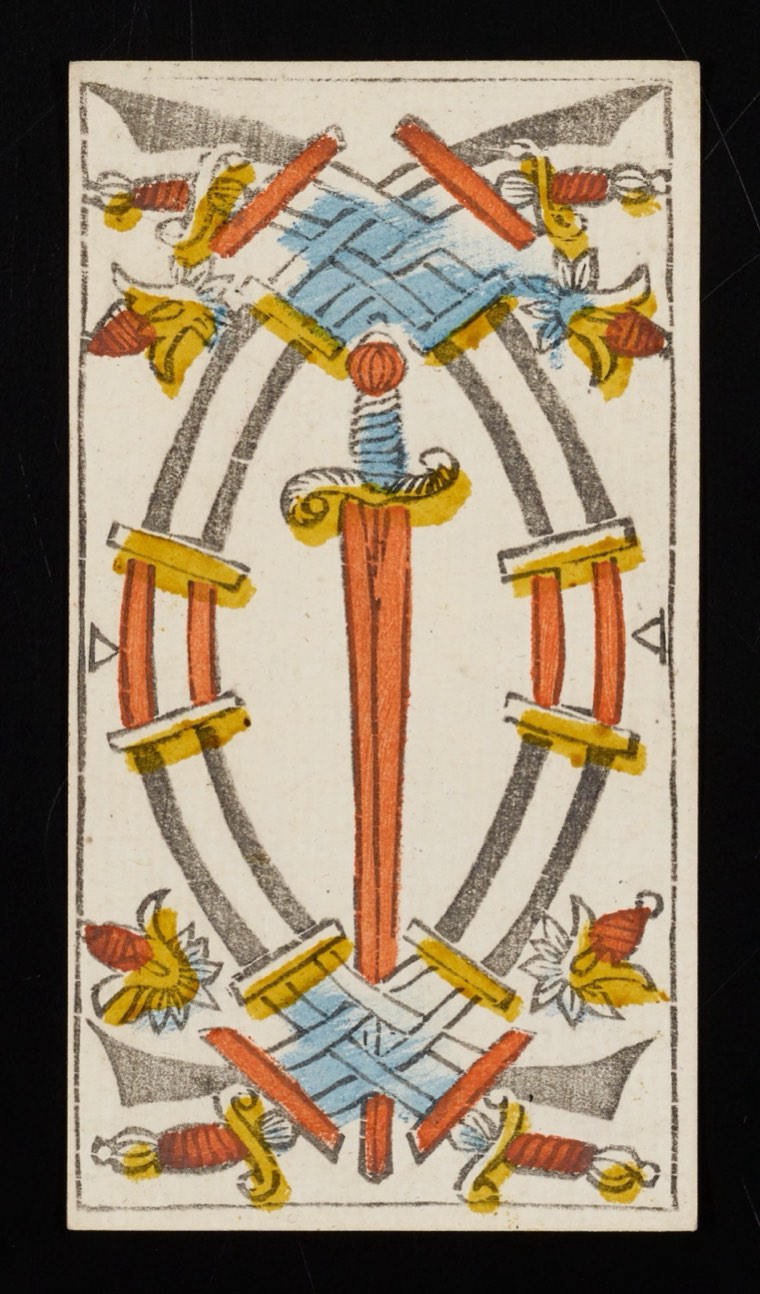
05 · Swords
Begin with the number and the suit.
This is not a miniature illustrated anecdote. Read Swords as discernment, language, conflict, boundaries, and decision, then let the number and visible arrangement specify how that quality is behaving.
Which visual cue makes Five of Swords recognizable before reading its title?
01 · Number
Five disturbs the symmetry.
Five introduces a center, interruption, test, or pressure that prevents the structure from remaining static.
Where does the pattern feel balanced, interrupted, enclosed, or still open?
02 · Geometry
Let arrangement modify the number.
Trace the blades, openings, crossings, and central spaces before deciding whether the pattern protects or restricts.
What changes when you read the spacing and direction before naming a meaning?
03 · Reading range
Hold the pattern as a continuum.
Constructively, this card may move through hollow victory, conflict, and humiliation. Under pressure, the same structure may show reconciliation, resentment, and making amends. The spread position and neighboring cards decide which part of the range is active.
How could hollow victory become distorted into reconciliation in this situation?
04 · Practice
Reveal the relational cost of winning at any price.
Reveal the relational cost of winning at any price. Its constructive range includes hollow victory, conflict, and humiliation; its difficult range can include reconciliation, resentment, and making amends. Test that reading against the number, suit, geometry, and the question rather than importing a scene that is not printed on the card.
Where is this function active in the situation: Reveal the relational cost of winning at any price.